Puttgarden-Rødby Ferry
The short Scandlines crossing between Germany and Denmark on the Vogelfluglinie.
- 45-minute crossing
- Usually every 30 minutes during the day
- Cars, motorhomes, motorbikes, bicycles and foot passengers
Independent route guide. Booking is completed directly with Scandlines.
Puttgarden-Rødby ferry guide
Table of Contents
The Puttgarden-Rødby ferry is the direct sea link from Germany to Denmark on the historic Vogelfluglinie. It crosses roughly 20 kilometres of the Fehmarn Belt in 45 minutes and avoids the longer drive through Jutland and across the Great Belt. For travellers heading from Hamburg or Lübeck towards Copenhagen, Malmö or southern Sweden, it turns the motorway journey into a short break at sea.
Scandlines operates the route with four double-ended hybrid ferries. Their design allows vehicles to drive through and helps the service maintain its frequent timetable. This page covers the complete crossing in one place: how to reach Puttgarden, check-in, what to expect on board, arrival in Rødby and how the ticket hand-off works. Times and availability can change, so use the departure table above for planning and confirm your chosen sailing with Scandlines on the day you travel.
Getting to Puttgarden ferry port
Puttgarden is on the northern tip of Fehmarn, an island on Germany's Baltic coast. By car, follow the A1 past Hamburg and Lübeck towards Heiligenhafen, then continue on the B207 across the Fehmarn Sound Bridge. The road ends at the ferry terminal, and signs for Puttgarden and Denmark make the final approach straightforward.
The terminal address is Fährhafenstraße, 23769 Puttgarden. If you are travelling without a car, the X85 express bus connects Lübeck central bus station with the ferry terminal while rail services to Puttgarden station are suspended during work related to the Fehmarn Belt tunnel. Check the current public transport connection before setting out, because replacement arrangements can change.
On the Danish side, the ferry arrives at Rødbyhavn on the island of Lolland. The terminal feeds directly onto the E47 towards Maribo and Copenhagen. Without a car, local bus connections link the port area with Maribo, where you can continue by train.
Check-in and boarding
Check-in closes 15 minutes before departure and opens two hours before the sailing. Scandlines recommends arriving at least 30 minutes before departure. During school holidays and other busy travel periods, allow extra time for queues in the vehicle lanes.
Cars up to six metres normally use the blue lane. A camera can read the number plate entered with the booking, or you can retrieve the reservation at the machine. The staffed yellow lane is used for longer vehicles, trailers, caravans, motorhomes over six metres, motorbikes, bicycles, travellers who need assistance and anyone buying a ticket at the port. Enter the full length of your vehicle and anything attached to it when booking.
Foot passengers check in inside the terminal and board by passenger bridge. Keep the booking confirmation and identity documents available. Germany and Denmark are both in the Schengen Area, but spot checks are possible and every traveller should carry the documents required for their nationality.
The 45 minutes on board
The vehicle deck is closed during the crossing, so take your phone, documents, medication and anything else you need upstairs before leaving the car. The passenger areas are designed for a short crossing. You will find a Food Express for meals and snacks, a coffee outlet and a shop. There is no buffet restaurant on this route, and Wi-Fi is available in the harbour waiting areas rather than on the ferries.
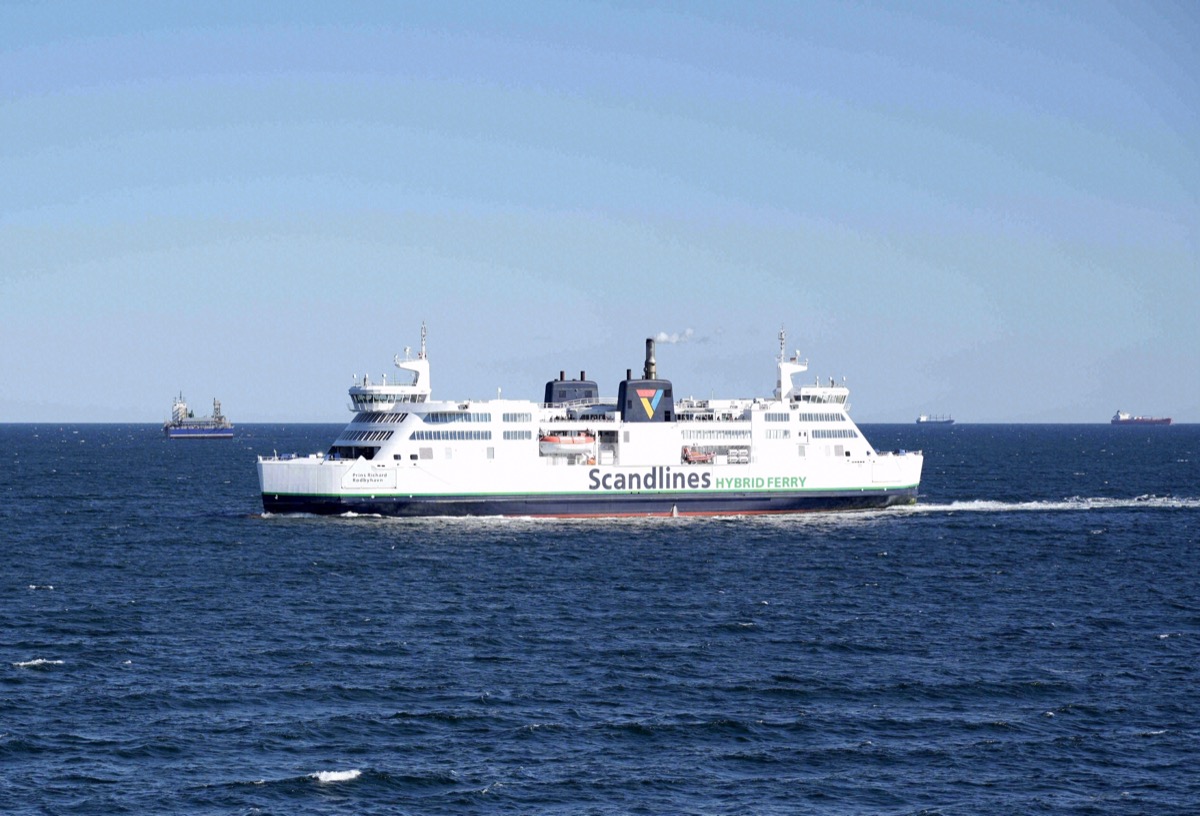
Payment on board is possible in euros or Danish kroner, with cards being the simplest option. There are open deck areas when conditions allow. The photographed ferry in the page header is Prins Richard, one of the hybrid vessels used on this route.
Dogs, cats and other small pets can travel without a separate ferry fare, but Danish entry rules still apply. Bring the required pet passport, vaccination evidence and any other documents relevant to your animal. Pets must remain in the permitted areas or in the vehicle where the operator allows it.
Arrival in Rødby and onward travel
Vehicles leave the ferry directly onto the E47. Copenhagen is roughly 160 kilometres from Rødbyhavn, normally about two hours by road via Lolland, Falster and Zealand. Travellers continuing to Sweden can cross the Øresund Bridge from Copenhagen to Malmö. Scandlines also sells combination products that join the ferry and bridge in one booking, depending on the market and vehicle.
In the opposite direction, arrival in Puttgarden puts you directly on the B207 towards the A1, Lübeck and Hamburg. The ferry remains the direct public crossing while the Fehmarn Belt tunnel is under construction.
Departures, tickets and booking
The route runs all year. During the day, departures are normally spaced about 30 minutes apart, while the overnight timetable is less frequent. Weather, maintenance or operational changes can alter individual sailings. For current operational information, check the official Scandlines departures before travelling.
Tickets are sold by vehicle category rather than simply by passenger count. The online booking flow asks for the vehicle type and total length, then shows the fares available for your date. Low Price is tied to the booked departure, while more flexible products can cover other departures on the same travel day. Foot passengers, cyclists and motorcyclists select their relevant category.
This site is an independent route guide. The booking buttons send you to Scandlines, which operates the ferry, issues the ticket and handles payment. The hand-off is in English, so there is no language change when you continue from this page.
Puttgarden - Rødby
The short sea route to Denmark
The Puttgarden-Rødby ferry links the German island of Fehmarn with Lolland in Denmark. Scandlines crosses the Fehmarn Belt in 45 minutes, normally every 30 minutes during the day and with up to 45 sailings in each direction.
It is the shortest ferry crossing between Germany and Denmark and a practical break on the drive towards Copenhagen or Sweden. Four hybrid ferries carry cars, motorhomes, motorbikes, bicycles and foot passengers.
- Crossing
- approx. 45 min
- Operator
- Scandlines
- Frequency
- up to 45×/direction
- Distance
- approx. 20 km
Puttgarden-Rødby departures
FAQ
Common questions about the Puttgarden-Rødby ferry
How long does the Puttgarden-Rødby ferry take? +
The crossing takes 45 minutes over the Fehmarn Belt.
How often does the ferry run? +
Scandlines normally sails every 30 minutes during the day, with a reduced service at night. Choose a date in the departure table above and confirm the sailing with Scandlines on your travel day.
Do I need to book in advance? +
You can buy a ticket at the harbour if space is available, but online fares are normally lower. The booking button takes you directly to the English Scandlines booking flow.
When should I arrive for check-in? +
Check-in closes 15 minutes before departure. Scandlines recommends arriving at least 30 minutes before your sailing, with more time during busy holiday periods.
Can I travel without a car? +
Yes. Foot passengers and cyclists can use the route, and motorbikes and motorhomes have their own vehicle categories in the booking flow.
Ready to cross the Fehmarn Belt?
Choose your sailing and continue to the English Scandlines booking flow.